
2016 TaylorMade M1 Rescue
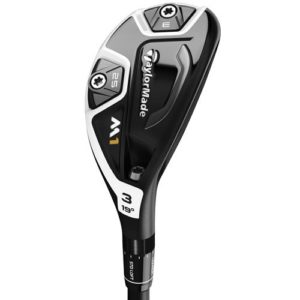 If you were to pick one word to describe TaylorMade’s M1 line, customization would be a good choice. As is the case with the M1 driver and fairway woods, the design of the M1 rescues was intended to give players every opportunity to personalize these clubs for maximum performance. Included in that functionality are moveable weights of 3 and 25 grams that can be positioned to create either a fade or neutral bias.
The M1 rescues, unlike the M2s, do not have a draw bias. Additionally, an adjustable loft sleeve gives players the option to change loft and lie to control trajectory and hit the ball the exact yardages they’re looking for. Also, compared to the M2, the M1 rescues have a more compact, tour-inspired shape, which will allow for greater workability. The stock shaft for the M1 hybrids is the Fujikura Pro 80, which at 79-87 grams depending on flex is significantly heavier than the stock shaft in the M2.
2016 TaylorMade M2 Rescue
 TaylorMade’s M2 rescue clubs share many of the same performance attributes as their M2 driver and fairway wood counterparts. These are clubs that were designed to produce high launch angles, be extremely forgiving, and create fast ball speeds. The catalyst for that performance is a redesigned Speed Pocket, which because of its increased flexibility creates higher MOI and faster ball speeds from impact points across the clubface.
Additionally, the CG in the M2 has been lowered to generate the higher launch angles. Compared to the M1 rescues, the M2 has a larger profile and its new shape was designed to inspire confidence in players who see it as visually easy to hit. Golfers can expect a bit of draw bias from the M2. TaylorMade’s REAX shaft, which varies in weight, is the stock option for the M2 hybrids, but other options are available at no upcharge as well.


