
When you hit the market looking to buy a new putter, there’s a lot to know. Putters get deep when it comes to personal preferences so you’ll be hit with a lot of options and terminology like: blade, mallet, MOI, toe hang and offset. At TGW we want to make this process easy. Check out our quick guide to putter lingo to arm yourself with knowledge on your quest to find the right flat stick for you.
Blade- Traditional putter look, longer and narrower, typically lighter in weight.
Center Shaft- The shaft connects to the putter head in the center, can be slightly more difficult to control.

This Cleveland Smart Square putter illustrates what a center shaft putter looks like at address.
Counterbalance- With the USGA anchoring ban going into effect in 2016, club makers are using more counterbalancing techniques, often but adding weight to the top of the club for a smoother stroke and more control.
Face Balanced- Balance the shaft on your finger and if the face points upward, you have a face balanced putter. Face balanced putters tend to open and close less during the putting stroke, making them ideal for golfers with a straight back and through motion.
Heel Shaft- The shaft connects near the heel of the putter head, traditional putter design.
Insert- Inserts are made of various materials and placed into the face of a putter to provide a softer feel with less audible feedback.
Mallet- Larger putter head, nearly as wide as they are long, often heavier in weight to eliminate wrist action and come in a wide variety of designs and alignment aids.
Milled Face- Metal faced putters feature milling in various patterns that maximize audible feedback that can help hear where the sweet spot is on the putter.
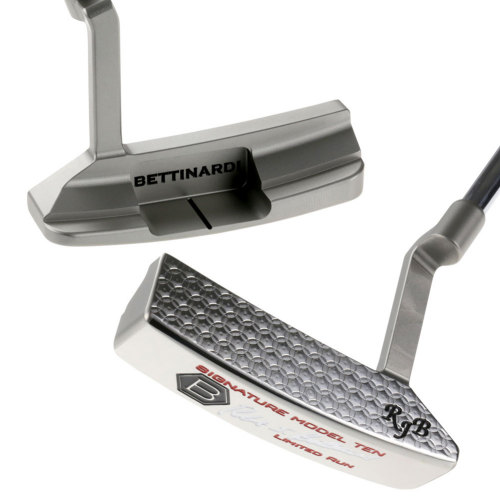
Bettinardi Putters specializes in milled putter faces with a variety of patterns like this honeycomb milling.
Moment of Inertia- Often shortened to MOI, this is simply the putter’s resistance to twisting. The higher the MOI, the more a putter resists twisting around the center.
Offset- Helps create a consistent set up by getting your eyes more over the ball to prevent leaning the shaft and changing the loft of the putter.
Perimeter Weighted- The weight of the putter head is distributed out to the edges of the putter to provide a larger sweet spot and more forgiveness on off-center putts.
Toe Balanced- When balancing the shaft on your finger and the toe points down, you have a toe balanced putter. Toe balanced putters accommodate a stroke that opens and closes so if you put along an arc, a toe balanced putter may be for you.
Toe Hang- Many putters are not face balanced or toe balanced. For those putters in that middle ground, you have toe hang, measured in degrees. The more arc your putting stroke has, the more toe hang you’ll want.
Toe Weighted- More weight is focused in the toe of the putter head, working with the natural arc of golfers who put on an arced path. Toe weighting is usually found in toe balanced putters.
Now that you’ve got the terminology down, head over to our full Putter Buying Guide to take a deeper look at all the options available in picking out a putter. With such a large amount of ways to personalize a putter, you’re sure to find one that fits your game precisely at TGW.


